How the $6.34 Billion Binance Hack Happened: From a Fake Job Interview to the Wallet Signing Service
On 29 October 2026 attackers moved about $6.34 billion out of Binance. The company says it began months earlier on its own engineers' computers. A timeline of what has been disclosed, what is still unconfirmed, and the lessons for any team that deploys from developer machines.
On 29 October 2026 attackers moved about $6.34 billion in crypto assets out of Binance, the largest theft from an exchange on record. Binance says customers have been made whole from the company's own funds. What makes the incident worth studying outside the crypto industry is where it started: not in a smart contract or a trading system, but on the laptops of the company's own engineers.
This article summarises what Binance has disclosed, as reported by CNBC and analysed by the security firm StepSecurity, and separates it from what is still unconfirmed. Binance's own report could not be read directly for this article, so every detail attributed to Binance below comes through those two sources.
Timeline
| When | What happened |
|---|---|
| June 2026 | A DevOps engineer on the wallet team searches for an AI coding tool and installs a tampered copy of the Homebrew package manager. Binance says it noticed an anomaly, replaced the device and rotated credentials. |
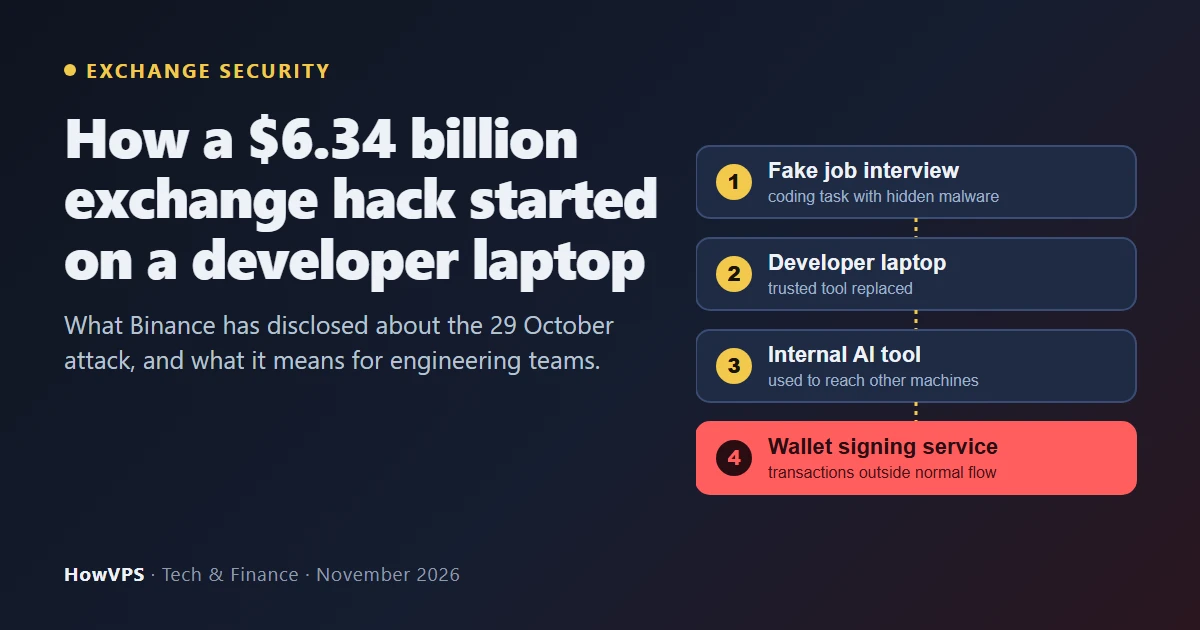
| September 2026 | A second engineer is approached through a recruitment platform. After several interviews, including live video, the engineer downloads a coding assignment onto a work computer. Setting it up runs hidden code that replaces part of a legitimate developer tool. |
| 20 October | From the second engineer's computer, the attackers use an internal AI tool to take control of two more machines, including the first engineer's. One holds a token that can deploy containers. |
| 29 October, 17:15 to 19:56 UTC | The attackers deploy a container, run a script and reach an internal wallet signing service, which starts transactions outside the normal withdrawal process. |
| 30 October, 00:10 UTC | Binance removes a malicious on-chain delegation from one of its Ethereum wallets, which had let transfers continue after withdrawals were suspended. |
| 31 October | The FBI attributes the attack to North Korea's TraderTraitor group, according to both sources. |
| 1 November | Selected withdrawals reopen. Binance reports $4.65 billion withdrawn against $1.01 billion deposited in the first nine and a half hours. |
| 3 November | Binance publishes its initial findings. Co-CEO Richard Teng tells CNBC an independent expert will review the company's response. |
| 12 November | Binance says all affected customer assets are covered and publishes a new reserves snapshot. |
The attack chain in plain words
- Get code onto a work computer. Twice, an engineer ran something that looked routine: an installer found through a search engine, and a take-home task from what appeared to be a recruiter. According to StepSecurity's reading of the report, the endpoint protection in place at the time did not flag the second one.
- Replace a trusted tool. The malicious code swapped a component of a common developer tool for a modified copy that contacted an outside server. The file was almost the same size as the original.
- Move sideways through an internal tool. Teng told CNBC the attackers moved through the company's internal AI tools. Binance has not named the tool or explained how it gave access to other machines.
- Use a credential that was sitting on a laptop. A token with permission to deploy containers was found on one engineer's machine.
- Ask the signing service to sign. With a container running inside the environment, the attackers reached the service that authorises wallet transactions. Transfers went out on Ethereum, Bitcoin, the XRP Ledger, Solana and Optimism.
No software vulnerability in the usual sense has been reported at any step. Each one used access that an engineer legitimately had.
Where the money stands
- Customers: Binance pledged to cover all losses from its own resources. It named three sources: its user protection fund (SAFU), part of its futures insurance funds, and the corporate treasury. Coverage was reported at about 90% on 31 October, about 98% in the first days of November, and complete on 12 November.
- The stolen assets: covered is not the same as recovered. Binance's figure is about $2.85 billion frozen or intercepted, with help from companies including Tether, Circle and Ripple according to CNBC. No recovered total has been published.
- Proof of reserves: Binance has published snapshots, but the cryptographic proof that lets customers check their own balance against it was still pending when crypto.news reported on 12 November. A reserves proof is also narrower than an audit: it shows assets at one moment and says nothing about liabilities.
What is still unconfirmed
- Which internal AI tool was involved and how it was abused.
- Whether the attackers had continuous access from June to October. Binance replaced the first device in June, and StepSecurity notes that continuous access has not been established.
- The amounts taken per asset and per blockchain.
- The result of the independent review, which had not been published at the time of writing.
- How the cost was finally split between the three funding sources.
Lessons for teams that are not crypto exchanges
Replace "wallet signing service" with "production deploy" or "customer database" and the same chain applies to most companies. StepSecurity's recommendations, condensed:
- Treat a take-home assignment or an unfamiliar repository as code execution. Open it in a disposable environment with no work login, no SSH agent and no access to your home directory. Install scripts, editor tasks and AI-assistant hooks all run code.
- Install tools from the project's own site or your package manager, not from a search result. Sponsored and look-alike results are a common way to deliver tampered installers.
- Keep deployment credentials off laptops. List which tokens on developer machines can create containers, push images or reach production, and move those actions to short-lived identities behind a separate approval step.
- Treat internal AI tools as privileged systems. Know which credentials and connectors each one holds, restrict what it may act on, and log both who asked and which identity acted.
- Limit what a critical service will do when asked, not only who may ask. A signing or deploy service should refuse requests outside its normal pattern.
- After a compromise, revoke from a clean machine and trace what the access created: new workloads, role grants, keys and anything that outlives a disabled account. Rebuild systems whose integrity you cannot establish.
For a small team with a VPS, the practical version is short: do not keep production SSH keys or cloud API tokens on the machine where you try out code from strangers, and use separate, limited credentials for deployment.
Sources
- CNBC: Binance co-CEO Richard Teng on how the attackers got in (3 November 2026).
- StepSecurity: analysis of the developer-machine attack chain (updated 3 November 2026).
- crypto.news: losses covered, reserve proof pending (12 November 2026).