Node.js 26.13.1, 24.22.3 and 22.23.5 Fix 16 Vulnerabilities, Seven Rated High
The Node.js security releases of 11 November 2026 fix 16 vulnerabilities. The seven rated high are all in HTTP/2 and TLS, and several can be triggered by any client that can reach the server.
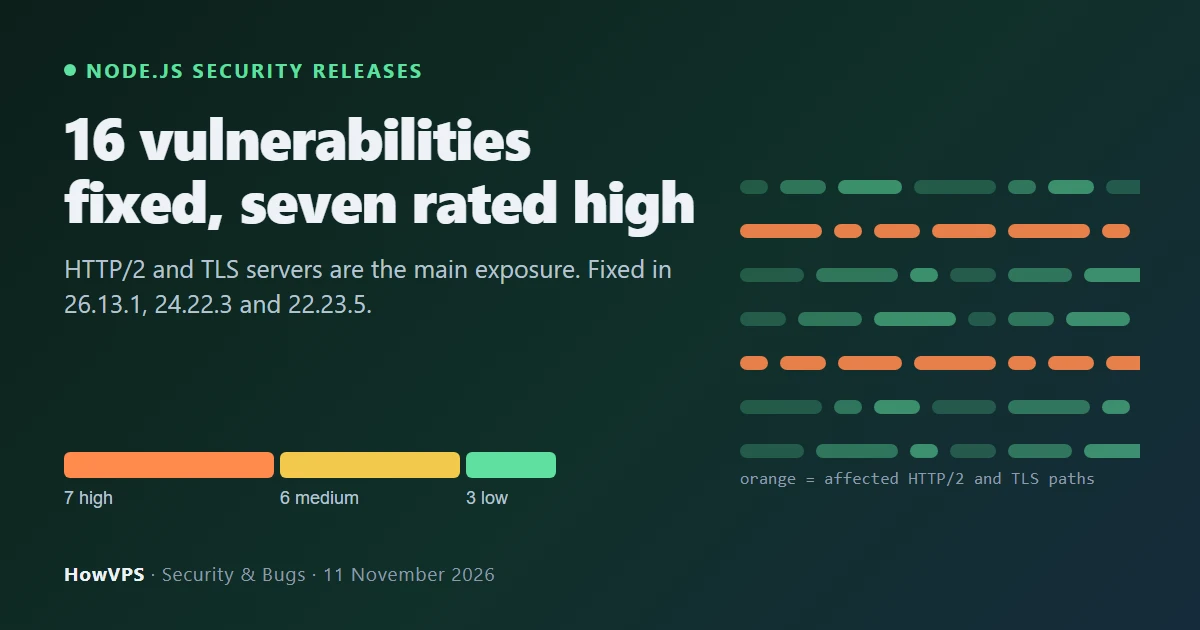
The Node.js project released security updates for all three supported release lines on 11 November 2026. They fix 16 vulnerabilities: seven rated high, six medium and three low. None is rated critical.
All seven high-severity issues are in HTTP/2 and TLS handling. If your application serves HTTPS or HTTP/2 directly from Node.js, this update matters most to you. If Node.js sits behind a reverse proxy such as Nginx that terminates TLS and speaks HTTP/1.1 to the application, several of the issues are not reachable from the internet, but updating is still the right move.
Fixed versions
| Release line | Update to |
|---|---|
| Node.js 26 | 26.13.1 |
| Node.js 24 | 24.22.3 |
| Node.js 22 | 22.23.5 |
Older lines get no update. The announcement repeats the project's standing warning that end-of-life versions are always affected when a security release happens.
The high-severity issues
| CVE | What can happen | Lines |
|---|---|---|
| CVE-2026-123864 | An HTTPS server can leak its own memory into a response body | 22, 24, 26 |
| CVE-2026-123863 | A client can crash the process during HTTP/2 session teardown | 24, 26 |
| CVE-2026-123865 | HTTP/2 sessions leak memory and sockets after a protocol error during shutdown | 22, 24, 26 |
| CVE-2026-123866 | HTTP/2 stream teardown can send freed memory to the peer | 22, 24, 26 |
| CVE-2026-123874 | Use-after-free when a file response is reset during a pending write | 24, 26 |
| CVE-2026-126051 | A client can crash TLS servers that use certain handshake callbacks | 24, 26 |
| CVE-2026-123872 | TLS 1.2 renegotiation lets a client get around per-host client-certificate rules | 22, 24, 26 |
Who is exposed
The announcement describes the conditions for each issue. In short:
- Any HTTP/2 server on Node.js 24 or 26 can be crashed by an unauthenticated client through CVE-2026-123863 when a handler responds before the request body has ended. No unusual configuration is needed.
- HTTPS servers are affected by the memory leak in CVE-2026-123864 when a handler sends headers early and then ends the response with data. Plain HTTP is not affected. To read the leaked memory an attacker also needs a route that echoes or stores what it receives.
- HTTP/2 servers that send files with
respondWithFile()orrespondWithFD()are exposed to CVE-2026-123874, and to a medium-rated crash (CVE-2026-123875) when clients cancel downloads. - TLS servers using
SNICallback, OCSP or session callbacks, oraddContext()can be crashed through CVE-2026-126051. - Servers that require client certificates per hostname are affected by CVE-2026-123872 and by a medium-rated bypass, CVE-2026-123867. Both need a client that already holds a certificate the server trusts for something.
The rest
The medium and low issues include a one-byte heap overflow in Http2Session.altsvc(), HTTP/2 data that was not counted against maxSessionMemory, proxy credentials printed in an error message, an https.Agent that reused a TLS session across requests with different CA settings, and three issues in the permission model and zlib. The releases also update bundled dependencies: llhttp on all three lines, undici on 24 and 26, and SQLite on 22 and 24.
What to do
- Check the running version with
node -von each server, and inside each container image. - Update to the fixed version of your line. With a version manager that is, for example,
nvm install 24.22.3; with Docker, rebuild from an updated base image tag. - Restart the application. A new binary on disk does not change a process that is already running.
- If Node.js comes from your distribution's packages, check its security tracker: distribution builds can arrive later than the upstream release.
- On an end-of-life line such as Node.js 20, plan the upgrade to a supported line. It will not receive these fixes.
Source
- Node.js: Wednesday, November 11, 2026 Security Releases, the project's announcement with the full list of CVEs and credits.