Microsoft Reports 59 Linux Kernel Bugs Found With AI Scanning; Eight Led to Root
A Microsoft research team scanned the Linux kernel with AI models and sent 59 bug reports upstream. 33 CVEs have been assigned so far, eight of them with a working local root exploit in the lab. What it means if you run Linux servers.
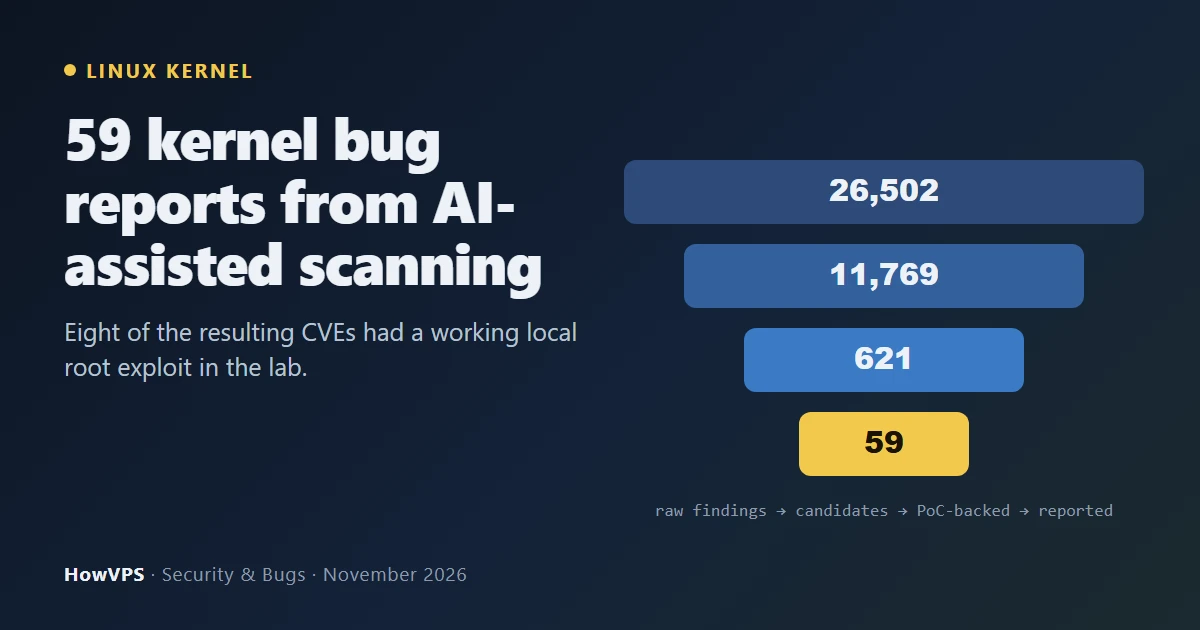
Microsoft's FORGE Lab published a write-up on 11 November 2026 about three months spent looking for bugs in the Linux kernel with AI models. The team sent 59 bug reports to the kernel's public mailing lists. So far 33 CVEs have been assigned, 24 of them rated high or above, and for eight the team confirmed a working exploit that takes a local user to root in a lab environment.
For anyone who runs Linux servers the practical message is short: these fixes arrive through ordinary kernel updates, so install them and reboot. The rest of this article explains what was found and why the numbers matter.
From 26,502 findings to 59 reports
The scans ran from late May to mid-June 2026 and produced 26,502 raw findings. Filtering left 11,769 candidates. Automated agents then tried to reproduce each one in a virtual machine, which left 621 cases backed by a proof of concept. After review by people, 59 were reported.
What happened to the other 562 is the interesting part. According to the post, 266 shared a root cause with another case, 163 were not reported because their security impact was limited, and 133 had already been reported or fixed by someone else.
The first report went out on 27 June. By the time of the post, fixes for 38 of the 59 reports had been merged into the mainline kernel. Half of the patches were accepted as first submitted; the others needed one to four revisions. The median time from first public patch to a mainline release was 41 days, and the longest was 108.
Old bugs, not new ones
The average bug was 8.1 years old when it was reported. Six had been in the kernel for 15 to 19 years and three for 20 years or more. One, in a network traffic classifier, is described as having been present for at least 21 years.
That has a consequence for servers: an old kernel is not a safe kernel. Long-lived code that nobody has reported on is not the same as code without bugs, and kernels on long-term-support distributions carry these bugs until the fix is backported.
The eight bugs with a root exploit
| CVE | Area | Type of bug |
|---|---|---|
| CVE-2026-64563 | Hash table library (rhashtable) | Use-after-free |
| CVE-2026-64554 | IPv6 networking | Use-after-free |
| CVE-2026-64580 | IPv6 IPsec routing | Reference count underflow |
| CVE-2026-74561 | IPv4 next-hop handling | Use-after-free |
| CVE-2026-74562 | IPv4 next-hop handling | Use-after-free |
| CVE-2026-89789 | GTP tunnel driver | Use-after-free |
| CVE-2026-98222 | Kernel key management | Heap buffer overflow |
| CVE-2026-98364 | IPsec routing (xfrm) | Use-after-free |
All eight are local privilege escalation bugs: the attacker must already be able to run code on the machine as an ordinary user. The post adds that some of the exploits needed non-default settings or disabled protections.
The exception worth noting is CVE-2026-64563. Microsoft says it gave a stable escalation to root without special kernel options or user namespaces, and that it also affected Android with SELinux enforcing. The fix is a one-line change; the bug itself dates back to a change made in 2018. No exploit code was published with the post.
What this means for a VPS
- Local bugs matter on shared and multi-user systems. On a server where only you have a shell, a local root bug needs another foothold first, such as a vulnerable web application. On shared hosting, CI runners, or any machine where others can run code, it is a direct path to root.
- The post gives no fixed kernel versions, so do not try to match version numbers by hand. Use your distribution's security tracker for the CVE you care about, and install the kernel updates it ships.
- A kernel update needs a reboot, or a live-patching service where your distribution offers one. Check with
uname -rthat the running kernel is the one you installed. - Expect more kernel updates, more often. The post's own conclusion is that finding bugs is now much faster than fixing them, and that the human work of reviewing and patching is the bottleneck.
A related fix to check for
Separately from Microsoft's batch, distributions have been shipping the fix for CVE-2026-80521, a race in the garbage collector for UNIX domain sockets. Red Hat rates it 7.8 (important), says an authenticated local user could use it to corrupt kernel memory and possibly gain privileges, and lists RHEL 10 as affected; RHEL 9 and earlier do not contain the affected code. Debian fixed it in trixie with kernel 6.12.111-1 (DSA-6528-1) and in bookworm with 6.1.190-1; bullseye is not affected. Red Hat lists no workaround, so the kernel update is the fix.