Cherokee Web Server on AlmaLinux 9 and Rocky Linux 9: Status and Alternatives
Cherokee has had no release since 2014 and its admin panel needs Python 2. Where the project stands, and how to set up Nginx on AlmaLinux 9 or Rocky Linux 9.
Cherokee is a lightweight web server best known for cherokee-admin, a browser-based control panel that let you add virtual hosts and rules without editing configuration files. If you are looking for a way to install it on a current RHEL-family server, the short answer is that you should not: the project has effectively stopped, and it depends on software that AlmaLinux 9 and Rocky Linux 9 no longer ship. This page explains the status and sets up a maintained lightweight web server, Nginx, in its place.
Where the Cherokee project stands
- Last release: the newest tag in the official repository is v1.2.104 from 1 April 2014. The project website still offers 1.2.103 as its download.
- Development: the GitHub repository is not formally archived, but the most recent commits on the main branch date from January 2023 and several hundred issues are open.
- Python 2: the build instructions call
./autogen.sh --with-python2=/usr/bin/python2, and the admin panel and theinstall.pyscript used by older tutorials are Python 2 programs. Python 2 reached end of life in 2020 and is not part of AlmaLinux 9 or Rocky Linux 9. - Packages: there is no package to install with
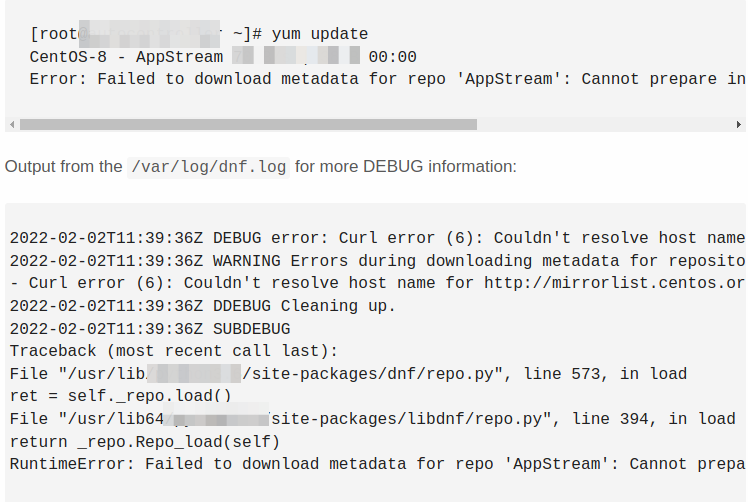
dnf; the only route is compiling a development snapshot yourself. - CentOS: the CentOS Linux releases Cherokee was commonly installed on are end-of-life as well (CentOS Linux 8 on 31 December 2021, CentOS Linux 7 on 30 June 2024).
A web server faces the internet directly. Running one that has had no release, and therefore no packaged security fixes, for more than a decade is a risk that no convenience feature justifies. Choose a server your distribution maintains.
What to use instead
- Nginx is in the AlmaLinux and Rocky Linux AppStream repository, receives security updates through
dnf, and is as light on memory as Cherokee was. It is the closest replacement and is set up below. - Apache httpd (
dnf install httpd) is the better fit if your applications rely on.htaccessfiles. - Caddy is worth a look if what you liked about Cherokee was not having to write much configuration: a site is a few lines and HTTPS certificates are obtained automatically.
None of these has a built-in web control panel like cherokee-admin. If you want to manage sites from a browser, install a maintained hosting control panel rather than an unmaintained web server.
Install Nginx on AlmaLinux 9 or Rocky Linux 9
Run these commands as a user with sudo rights. Install the package, then enable and start the service:
sudo dnf install nginx
sudo systemctl enable --now nginx
Open the HTTP and HTTPS ports in firewalld:
sudo firewall-cmd --permanent --add-service=http --add-service=https
sudo firewall-cmd --reload
Browse to http://203.0.113.10/ (your server's address). The default test page is served from /usr/share/nginx/html.
Add a site
Create a directory for the site and a test page. Content under /var/www already carries the SELinux label that lets a web server read it:
sudo mkdir -p /var/www/example.com
echo "It works" | sudo tee /var/www/example.com/index.html
Nginx loads every .conf file in /etc/nginx/conf.d/. Create /etc/nginx/conf.d/example.com.conf:
server {
    listen 80;
    listen [::]:80;
    server_name example.com www.example.com;
    root /var/www/example.com;
    index index.html;
}
Test the configuration and reload:
sudo nginx -t
sudo systemctl reload nginx
Check the result from the server itself:
curl -H "Host: example.com" http://127.0.0.1/From here, add a TLS certificate before the site goes live, and keep the server patched with sudo dnf upgrade.
Frequently asked questions
Can I still compile Cherokee from source?
The source is on GitHub and the README describes an autotools build, but you would have to supply your own Python 2 interpreter, fix whatever no longer compiles against current libraries, and track security problems yourself. For a server exposed to the internet that is not a sensible trade.
I already run Cherokee. How do I move away from it?
List the virtual hosts and rules in cherokee.conf (or in the admin panel), recreate each one as an Nginx server block, and test the new server on another port or machine before switching DNS or stopping Cherokee. Static sites and reverse proxies translate directly; FastCGI and uWSGI sources become fastcgi_pass and uwsgi_pass directives.
Is there a web server with a built-in admin interface?
OpenLiteSpeed ships with a web administration console and is actively maintained. Otherwise, a hosting control panel that manages Nginx or Apache for you gives the same point-and-click workflow.